Give your coding agent the right code, not more code.
LemonCrow plugs into the coding agent you already use. It finds the relevant code first, keeps noisy tool output out of the working set, carries useful task state, and verifies changes before the agent stops.
$ curl -fsSL https://install.lemoncrow.com | bashWorks with





LemonCrow Runtime product summary
LemonCrow is an open-source, local-first context and execution runtime for coding agents. It gives existing hosts including LemonCode, Claude Code, Codex, and opencode a ranked code graph, exact-range reads, bounded tool output, persistent memory, compaction support, and auditable session traces. LemonCode is LemonCrow's own opencode fork, the one host it controls end to end. LemonCrow is not an AI model, model provider, IDE, or hosted coding agent.
Every LemonCrow persona follows a code-hygiene ladder — reuse existing code,
prefer the standard library and native platform features, and write the
minimum that works — without trading away validation, error handling,
security, or accessibility. Deliberate shortcuts are tagged with an
lc-debt: marker and harvested into a ledger with
lc debt.
On the published SWE-bench Verified evaluation, LemonCrow used the same model while resolving 92.8% of runs versus 80.8% for baseline, a 12.0 percentage-point improvement, with 37.7% fewer turns and 23.7% less wall-clock time. Cost was 29.5% lower in that run, a measured consequence of the tighter loop. On Terminal-Bench 2.1, with both arms run at 89 tasks x 5 reps, LemonCrow tied baseline at 78.9% resolved while sending 98.6% fewer fresh input tokens and costing 16.0% less once cache-write pricing is normalized to a matched tier. These are benchmark results, not guarantees for every repository or task.
What changes
A ranked answer, not a search transcript.
LemonCrow changes the path your existing agent takes through a repository. It does not replace the model or the editor.
No repo map or pseudo-index to maintain.
Large codebases change too quickly for hand-written hierarchy files, symbol maps, or agent notes to stay useful. LemonCrow builds and incrementally refreshes the code index automatically, then finds the relevant symbols and relationships when the agent needs them.
- 01Search the repo broadly
- 02Open large files to find the useful lines
- 03Repeat searches as the task changes
- 04Carry exploration noise into the next turn
- 01Rank the relevant symbols first
- 02Return exact source ranges and relationships
- 03Keep command and tool output bounded
- 04Carry decisions and useful task state forward
Find
Right symbol first
Read
Only the lines needed
Carry
Keep useful state
Verify
Prove the change works
Matched proof
Cleaner context should finish more work—not just process fewer tokens.
The flagship SWE-bench Verified evaluation held the model, tasks, containers, turn limits, and verification harness constant. Only the LemonCrow runtime changed.
tasks resolved
80.8% baseline
resolution rate
same model and tasks
fewer turns
6,962 → 4,336
faster
14.3h → 10.9h
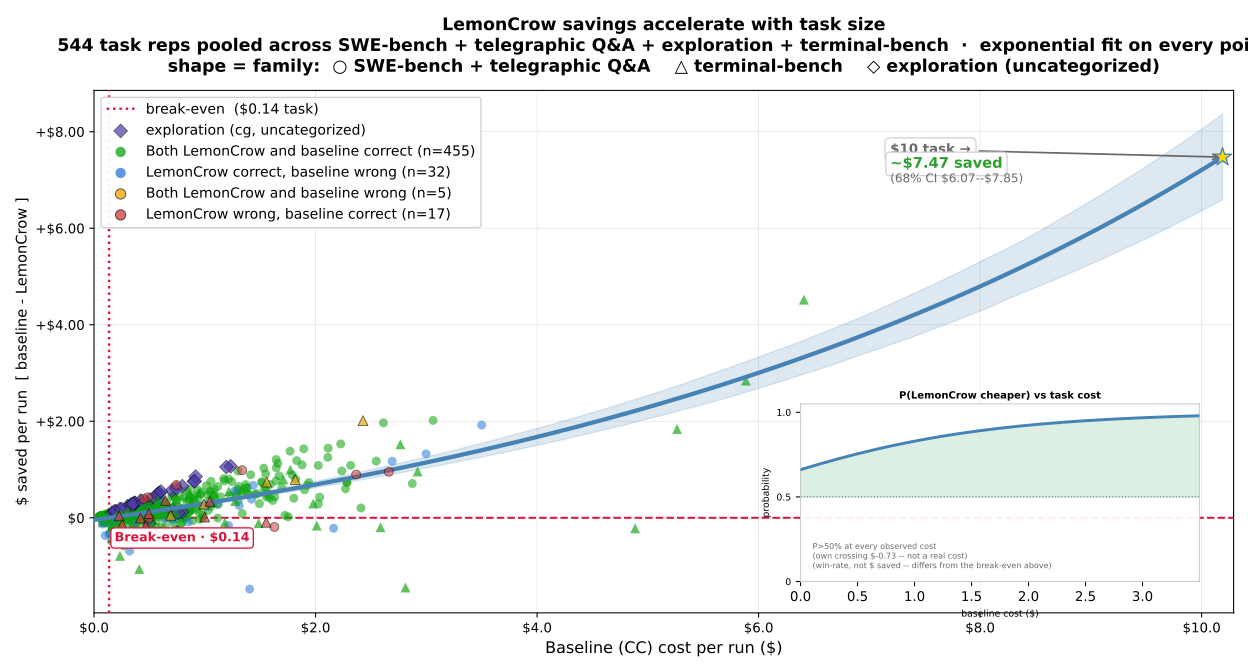
Cost was 29.5% lower in the same SWE-bench Verified run. It is a measured consequence of the tighter loop, not the primary promise. Results vary by repository and task.
Methodology + raw runs →How it works
Install → map → stay sharp.
Step 01
Install
One command adds the MCP server, agents, skills, and hooks to every host you use.
$ curl -fsSL https://install.lemoncrow.com | bash
Step 02
It auto-indexesAUTO
Tree-sitter parses your repo into LemonGraph — a symbol table ranked by call-graph centrality — then keeps itself fresh, only re-parsing files that changed. No step in your loop.
✓ indexed · 24 languages · incremental
Step 03
Stay sharpBOUNDED
The agent gets ranked symbols, exact ranges, bounded output, and reusable state instead of carrying the whole exploration transcript.
code_search("chargeCard")
→ source · 3 callers · 2 callees
The first useful result
The answer arrives with its neighborhood.
Ask for chargeCard(). LemonCrow returns the definition that matters, the callers leading into it, the callees it depends on, and only the source ranges needed next.
The agent can act from the first result instead of building context from a trail of grep output.
code_search("chargeCard")Prove it on your own history · read-only
See your number before you take ours.
Two read-only reports, no model re-run, nothing leaves your machine. Run one against your own Claude/Codex history to count the wasted round-trips and the tokens and cost that fall out of them. Or replay a recorded session to trace the repeated searches and oversized reads directly, and see how a tighter working set changes the path.
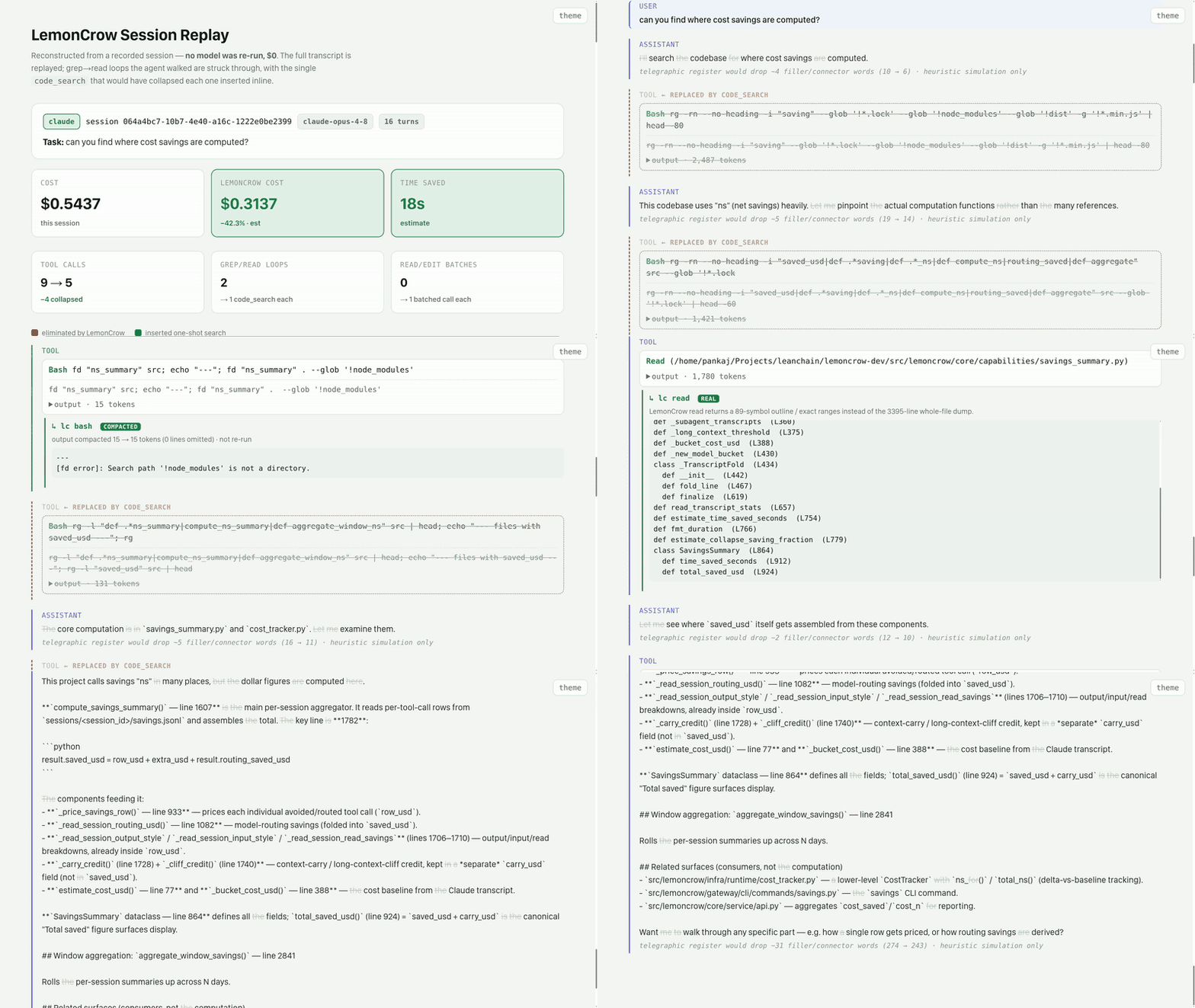
Your savings, 60 seconds after install
$ lemoncrow session statsThe wandering, before you install
$ lemoncrow session replayScans local agent sessions · temporary store · no login · no API keys.
Local-first
Improve the agent without shipping your repo to another index.
LemonCrow adds a local code-intelligence and context runtime. Anonymous usage telemetry is on by default—counts, not source or prompts—and the one command below turns it off.
On-device
The code graph stays local.
Parsing and indexing run on your hardware. The symbol index is stored on disk, so using LemonCrow does not require uploading your repository to a hosted index.
Your provider
No new destination for prompts.
Model calls still go to the provider and account your coding agent already uses, so LemonCrow does not add a separate model bill. It sits on the local tool path between that agent and your repository.
Inspectable
Check the boundary yourself.
Everything is Apache-2.0 — runtime, engine, and integrations, with nothing compiled-only. Benchmark inputs, outputs, and reproduction commands are public.
Same model · one command
Try LemonCrow on the repo that makes your agent wander.
Keep your model, editor, and workflow. Add LemonCrow locally and judge the difference on your own code.